
Family gaming isn’t just about finding age-appropriate titles, it’s about creating meaningful experiences that bring families together. There are a number of ways to approach creating these experiences, including curating the games you’re playing, but what we really needed was a reliable, approachable framework through which parents, guardians, and kids can work together to achieve those goals together.
At Engaged Family Gaming, we’re excited to introduce a powerful new approach we’ve developed that we call “the GCOP Framework.”
What is the GCOP Framework?
The GCOP Framework stands for –
- Guidance
- Celebration
- Observation
- Participation
It provides parents with a reasonable approach to engage with their children through gaming. Each part plays a vital role in creating positive family gaming experiences that go beyond simply playing games together.
We designed the GCOP Framework as a holistic approach, taking into account the many facets of what goes into designing a compassionate, loving, deeply connected family gaming experience that has the potential to create memories and connect families across generations through video games.

Guidance involves actively shaping the gaming experience by setting boundaries, providing context, and helping children navigate gaming in age-appropriate ways.
Why Guidance Matters
Guidance creates a safe gaming environment tailored to each child’s maturity level, rather than leaning on age alone as an indicator of “readiness”. When we’re able to guide our children through video games, rather than playing for them, we’re actively encouraging them to develop critical thinking about media consumption, as well as transforming gaming from a passive experience into a myriad of learning opportunities.
Through providing Guidance, our children will be better able to assess and tackle challenges related to the media that they’re engaging with and/or consuming. Our children will one day move out and live their own lives, so the goal of Guidance is to help them build an array of skills that they can draw on when they have to set their own “screentime rules” or build their own video game libraries of content that feels right for them.
Practical Examples:
- Researching game ratings and content before purchasing
- Setting clear time limits and expectations for gaming sessions
- Having conversations about challenging content in games
- Helping a child navigate a difficult level without taking over

Why Celebration Matters
It seems like a bit of a no-brainer to Celebrate our children, but we often get lost in the hazy shuffle of day-to-day life and Celebration can become an afterthought. When we Celebrate our children as they’re learning, connecting, and growing through family gaming, we create positive associations with that time, such that our children will look forward to it, even when they’re older.
Celebration through validation, where we acknowledge and appreciate our children’s hobbies and pastimes (even if they’re not video games), builds self-confidence over time and helps to highlight the valuable skills that our children are learning through the act of play. When our children feel Celebrated, they feel seen and understood, even if it’s just in that moment. Those moments add up over time!
Practical Examples:
- Congratulating a child who finally beats a challenging boss
- Displaying artwork inspired by favorite games
- Taking screenshots of impressive in-game builds or creations
- Creating family gaming tournaments with small prizes or trophies

Why Observation Matters
Observing our children isn’t about watching over them or being a helicopter. Instead, Observation is about providing insights into your child’s thought-processes and decision-making skills. There are times when you’ll be able to understand them immediately — drawing a line between your own experiences and theirs — but there will be many more moments where you’ll need to ask and, of course, Observe.
These Observations can also reveal potential concerns that may need to be addressed. For example, if your child is struggling to connect with their friends in video games, Observation can give you a framework for understanding why that might be.
Observing your child can also create opportunities for meaningful conversation about what you noticed while they were playing, whether that was solo or with others. You’ll be able to ask insightful questions about their experiences or even be able to share stories about those moments (even if you weren’t actively playing the game yourself).
Practical Examples:
- Noticing how a child approaches puzzle-solving in a game
- Paying attention to emotional reactions to in-game challenges
- Watching how a child interacts with others in multiplayer environments
- Observing which game elements capture your child’s interest most
Why Participation Matters
Think back to when you were a kid, showing your parent(s) and/or guardian(s) what you were excited about at that moment. Did your trusted adult(s) engage with you and attempt to Participate? Or did they pat you on the head and do their best to placate you so that they could go back to watching TV?
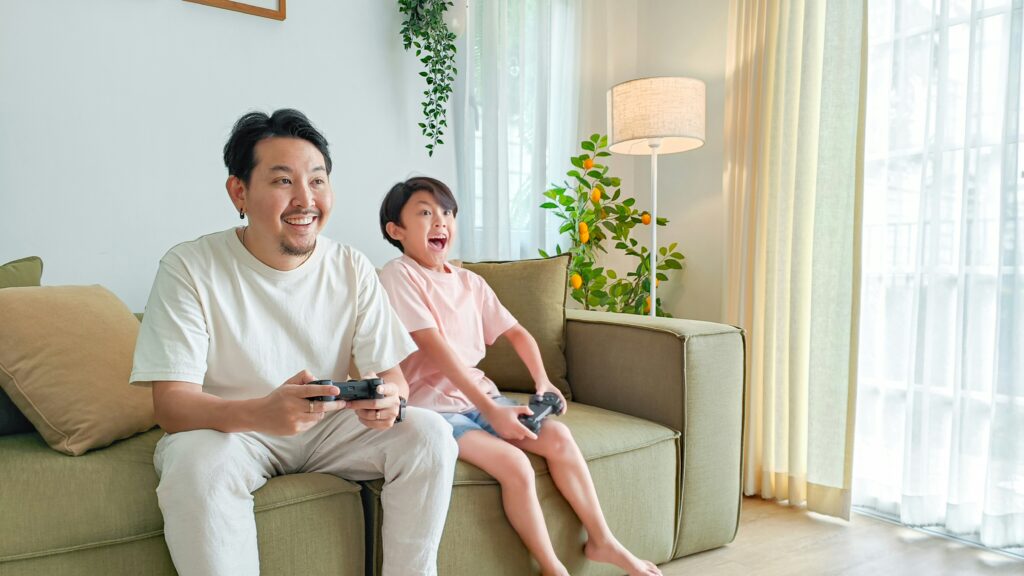
Participation matters on many, many levels. It gives us, as parents and guardians, unique opportunities to make memories. There will come a time when your child is old enough to look back fondly on their gaming experiences with you and yearn for that, perhaps even digging out an old console or sitting and talking about how it felt.
If Celebration builds self-confidence in children, Participation builds bonds through showing respect for your child’s interests in a hands-on way. And when those bonds are strong, you’ll be able to more easily build communication channels through these shared activities and experiences that can sustain through the (sometimes) difficult teen years.
Practical Examples:
- Taking turns playing a single-player game as a family
- Joining a child’s Minecraft world to build together
- Learning to play a fighting game for family tournaments
- Creating family teams for cooperative games

Putting GCOP Into Action
The beauty of the GCOP Framework is its flexibility. You don’t need to implement all four components at once or in equal measure.
For example:
- For younger children, Guidance and Participation might take precedence
- With tweens, Observation becomes increasingly valuable as they develop independence
- For teenagers, Celebration might help maintain connection while respecting autonomy
While we focused specifically about video games in our examples, the GCOP framework can be applied to all types of gaming: video games, board games, tabletop RPGs, and more. It has the potential to transform gaming from a source of family conflict into an opportunity for connection and growth.
Getting Started with GCOP
Begin by identifying one component that feels most natural to your family’s current gaming habits. Maybe you’re already great at Participating but could strengthen your Observation skills through being a bit more passive. Or perhaps you provide excellent Guidance but haven’t focused on Celebration, therefore are missing a crucial piece of connection with your child.
Small adjustments make a big difference, especially when there’s a focus on making long-term sustainable change in service of your child(ren)’s future.
Try implementing one new GCOP practice this week, and watch what it does!
About The Author